


The US Imposes 25% Tariff on Nvidia’s H200 AI Chips Headed to China
The U.S. government has formally imposed a 25% tariff on Nvidia’s advanced H200 AI semiconductors destined for China, a move that highlights how technology policy and geopolitics are converging in the global AI race. This development not only affects chip economics but signals broader strategic maneuvers as the United States seeks to balance national security, technological leadership, and domestic semiconductor manufacturing.
In this blog, we’ll break down the tariff decision, its implications for Nvidia and global supply chains, and what it means for U.S.–China tech competition in 2026.
What Happened? A Major New Tariff on AI Chips
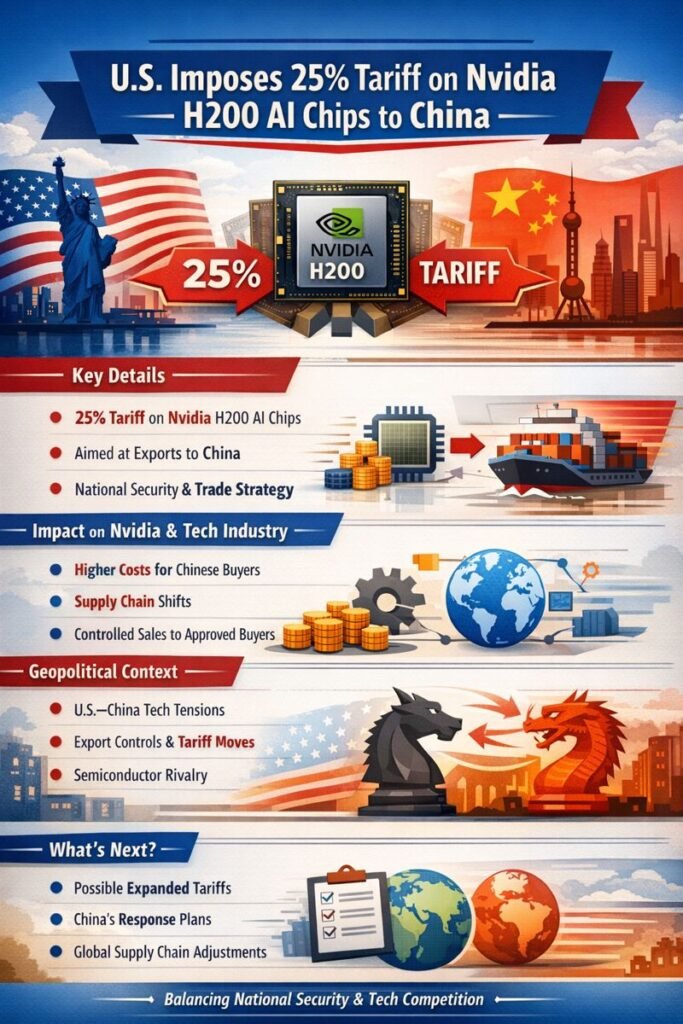
On January 14‑15, 2026, the White House announced that it would impose a 25% tariff on certain advanced AI semiconductor chips, including Nvidia’s flagship H200 processor and AMD’s MI325X, when these chips are imported into the United States and then exported to China or other foreign markets.
President Trump signed the proclamation under trade authority to address “national security risks” tied to heavy reliance on foreign semiconductor production — particularly from Asia — and to capture a share of the value from high‑end chip exports.
Why the Tariff Matters
1. Strategic Access, With a Cost
This tariff is part of a broader deal allowing Nvidia to sell H200 chips to vetted commercial customers in China. Previously, the export of advanced processors to China was restricted over national security concerns. The tariff effectively allows controlled access while extracting revenue for the U.S. government.
Nvidia has publicly applauded the decision, noting that the framework supports American chip manufacturing and jobs while enabling commercial opportunities abroad.
2. A Targeted, Not Broad, Approach
Unlike earlier proposals to slap tariffs on a wide range of foreign semiconductors, this levy is narrowly focused on high‑end AI chips that meet specific performance thresholds and that transit U.S. ports before export. This narrow scope tries to balance economic policy with supply chain realities.
Excluded from the tariff are semiconductors imported for U.S. data centers, startups, consumer applications, and domestic tech builds, allowing the internal U.S. market to continue innovating relatively unencumbered.
3. Part of the US Strategy to Bolster Domestic Manufacturing
The tariff also feeds into a longstanding U.S. goal: reducing reliance on overseas chip production. The U.S. currently produces a fraction of the most advanced semiconductors it uses — a situation viewed as both an economic vulnerability and a strategic weakness.
By imposing tariffs and using them as negotiation leverage, policymakers hope to incentivize more production and R&D bases inside the United States. While fiscal incentives like tax breaks and subsidies are part of this mix, tariffs act as a trade‑policy lever in shaping long‑term supply chains.
Industry Reaction and Market Dynamics
Nvidia’s Position
Even with the tariff cost, Nvidia appears positioned to continue shipments of H200 chips to approved Chinese customers. Demand remains strong, and production plans are reportedly being adjusted in response to early orders from China.
Analysts note that the tariff risk could increase prices for Chinese buyers but doesn’t entirely derail commercial access — a compromise that keeps U.S. chipmakers in the game while embedding economic benefits for Washington.
Global Tech Competition and Broader Impacts
Geopolitical Tech Tension
This policy is symptomatic of the ongoing U.S.–China tech rivalry, where semiconductors and AI hardware play central roles. Export controls, tariffs, and licensing rules have been tools in both nations’ efforts to maintain technological advantages and safeguard security interests.
China, in particular, has sought to cultivate its own semiconductor ecosystem while navigating these export restrictions — at times retaliating with its own tariffs and controls on key materials.
Supply Chain Effects
The tariff could shift supply chain strategies for chipmakers and cloud providers alike. Some firms may reroute logistics, redesign products to avoid tariff applicability, or adjust pricing strategies in affected markets.
It also shines a spotlight on the risk of over‑dependence on offshore manufacturing — particularly in East Asia — reinforcing U.S. policies aimed at reshoring critical tech production.
What’s Next? Potential Developments
- Expanded tariff lists: The White House has signaled that broader semiconductor tariffs could be enacted in the future if negotiations and supply chain restructuring don’t proceed as desired.
- Supply chain agreements: U.S. trade officials have been directed to negotiate agreements that may redefine how imports and exports are managed.
- Chinese regulatory responses: Beijing’s future moves — whether tariff retaliation, import policy changes, or domestic chip investments — will be closely watched by markets and policymakers alike.
The imposition of a 25% tariff on Nvidia’s H200 AI chips exported to China marks a significant moment in global tech policy. It reflects a sophisticated attempt to marry trade leverage with national security, economic interest, and the broader competition for AI and semiconductor leadership.
For Nvidia and other major chipmakers, this represents both a challenge and a structured pathway into one of the world’s largest tech markets — albeit at a higher cost. For the U.S., it’s a strategic step toward reshaping global semiconductor dynamics in an era where AI is a defining economic and geopolitical force.
Further Reading & Insight
- U.S. Imposes 25% Duty on Nvidia H200 Chips — TechCrunch report on tariff details.
- Analysis of Trump’s Technology Tariff Strategy — Axios coverage on policy impact.
- Reuters Summary of Tariff Scope and Exemptions — Tariff specifics and implications.